The UAE payment landscape in 2026: a guide for businesses
Who runs payments in the UAE, how Aani and Jaywan work, what customers use at checkout, and what it all means for a company that needs to get paid.
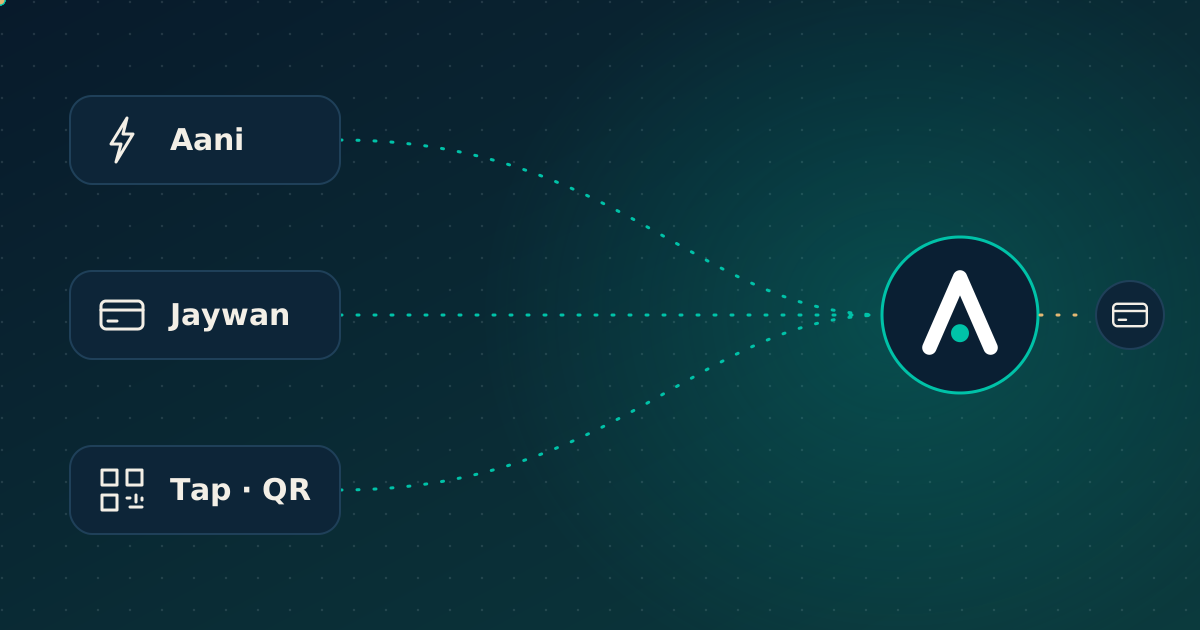
The UAE has one of the fastest-changing payment markets in the region. In three years it has added a national instant payment platform and a national card scheme on top of an already card-heavy economy. This guide covers the parts a business owner needs to understand.
Who runs payments in the UAE?
The Central Bank of the UAE (CBUAE) licenses and supervises banks, payment providers and stored-value wallets. Its subsidiary, Al Etihad Payments (AEP), owns and operates the national payment infrastructure, including Aani and Jaywan. Financial free zones such as DIFC and ADGM have their own regulators for firms based there.
What is Aani?
Aani is the UAE's national instant payment platform. It went live in October 2023 and lets people and businesses send money in real time, at any hour, using a mobile number or a QR code instead of an IBAN. A single transfer is capped at AED 50,000.
Adoption has been quick. In April 2026 AEP reported more than 12.5 million registered users across 74 licensed financial institutions and roughly 774,000 merchants, with the number of transfers up sixfold year on year. AEP has named cross-border payments, electronic direct debits, e-cheques and business-to-business payments as services planned for the platform.
What is Jaywan?
Jaywan is the UAE's first national card scheme. It was inaugurated on 20 July 2026, with banks and other licensed institutions issuing cards in phases. Debit, prepaid and credit cards are all supported, and they work at point-of-sale terminals, online, at ATMs and inside digital wallets.
Cards come in two forms. A mono-badge card carries only the Jaywan brand and is meant for domestic and GCC use. A co-badge card pairs Jaywan with an international network so it also works abroad. AEP and Mastercard announced the first Jaywan co-badged credit card the day after the launch. In August 2026 the Ministry of Finance added both Aani and Jaywan as payment channels for federal fees.
How do customers pay at checkout?
Contactless cards and phone wallets remain the everyday habit in shops and restaurants. Two shifts matter for a small business:
- Tap to Pay on a phone. A merchant can now accept contactless payments on a standard smartphone, without a separate terminal.
- Payment links and QR. Selling over chat and social media has made links and QR codes a normal way to pay, including for services delivered at the customer's door.
Payment methods at a glance
| Method | Best for | What the business needs |
|---|---|---|
| Contactless card or phone wallet | In-person sales | A terminal, or Tap to Pay on a phone |
| Payment link | Remote sales, invoices, deposits | An acceptance provider that issues links |
| QR code | Counters, tables, deliveries | A QR-capable acceptance app |
| Aani instant transfer | Account-to-account payments up to AED 50,000 | An account with a participating institution |
| Bank transfer to IBAN | Larger business invoices | An IBAN in the company's name |
How do companies pay salaries?
Employers registered with the Ministry of Human Resources and Emiratisation pay wages through the Wages Protection System (WPS), which routes salaries through approved channels so that payment can be verified. For a small company, this means the account that receives sales and the route that pays salaries need to connect cleanly.
What is changing next?
Two areas to watch. Open finance rules from the CBUAE are extending the national programme from payment rails to customer data. And under the CBUAE's Payment Token Services Regulation, domestic payments for goods and services with stablecoins are limited to licensed, dirham-backed tokens.
What does this mean for your company?
- Accept the methods your customers already use: tap, link and QR cover most situations.
- Have an IBAN in the company's name for transfers and larger invoices.
- Know how long each method takes to become money you can spend.
- Keep sales, spending and salaries close together, so cash does not sit idle between providers.
That last point is the reason Avora Money exists.
This article is general information, not financial, legal or compliance advice.
Sources
- Payment Expert: UAE fintech hub, open finance, Aani and what's next (21 October 2026)
- Zawya / Al Etihad Payments: Aani results announcement (10 April 2026)
- The National: UAE expands federal payment channels with Aani and Jaywan (3 August 2026)
- WAM: Mansour bin Zayed inaugurates Jaywan, the UAE's first national card scheme (20 July 2026)
- Emirates 24/7: What is Jaywan? (21 July 2026)
- Vixio: UAE debuts domestic payment card