UAE Open Finance and E-Invoicing: What SMEs Need to Know Before 2027
UAE SMEs: key e-invoicing deadlines (31 Mar and 1 Jul 2027), how Al Tareq open finance works, what to do now and what you gain.
Last updated: 21 November 2026
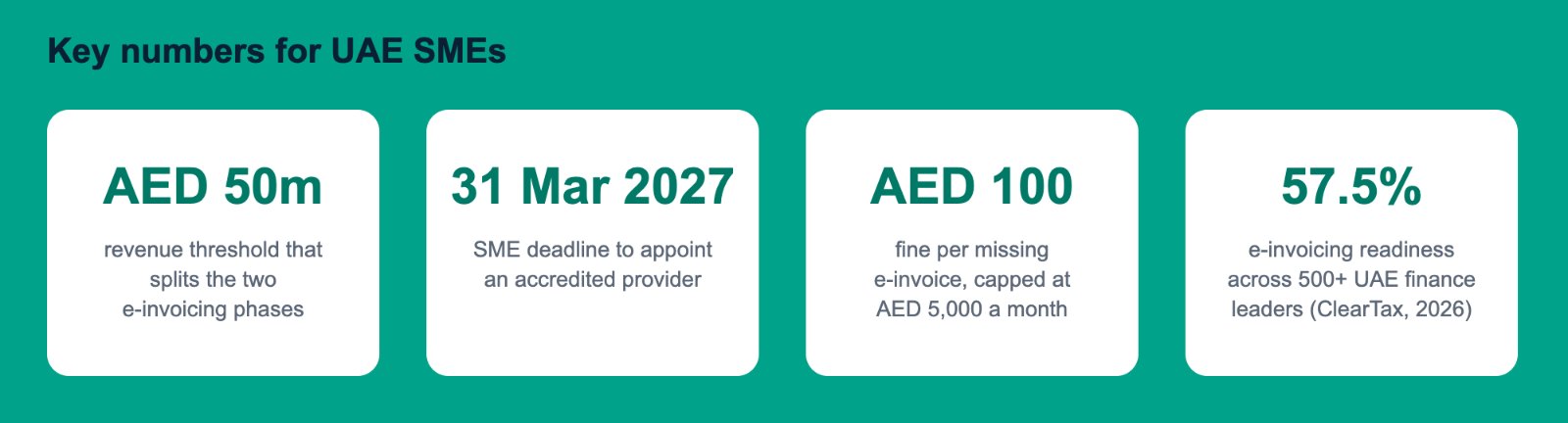
In short: UAE e-invoicing becomes mandatory for businesses with revenue below AED 50 million on 1 July 2027, and they must appoint an Accredited Service Provider (ASP) by 31 March 2027. Open finance, run by the Central Bank of the UAE (CBUAE) through the Al Tareq platform, is already live with the first banks and licensed providers. It lets a business share its bank data or start payments with a licensed provider, but only with the business's explicit consent. Both shifts turn SME finance into structured, digital data, and the SMEs that prepare early gain the most.
Key takeaways
- E-invoicing deadline for SMEs: appoint an ASP by 31 March 2027 and go live by 1 July 2027 if your revenue is below AED 50 million.
- What changes: invoices become structured XML data (PINT AE format) sent through accredited providers, not PDFs or emails. It covers business-to-business (B2B) and business-to-government (B2G) sales.
- Open finance is live: Al Tareq, the CBUAE's open finance platform, has processed live transactions since July 2025. Participation is mandatory for licensed institutions, and optional for you.
- What to do now: check your revenue threshold, clean your customer data, shortlist providers and test before the deadline.
- What you gain: fewer invoicing errors, faster reconciliation, and a path to credit based on verified cash flow instead of collateral.
What is e-invoicing in the UAE?
E-invoicing in the UAE is a national system where invoices are issued, exchanged and reported digitally as structured data. An e-invoice is a machine-readable XML file in the PINT AE format, the UAE version of the Peppol International Invoice standard, built on UBL 2.1. A PDF sent by email does not count.
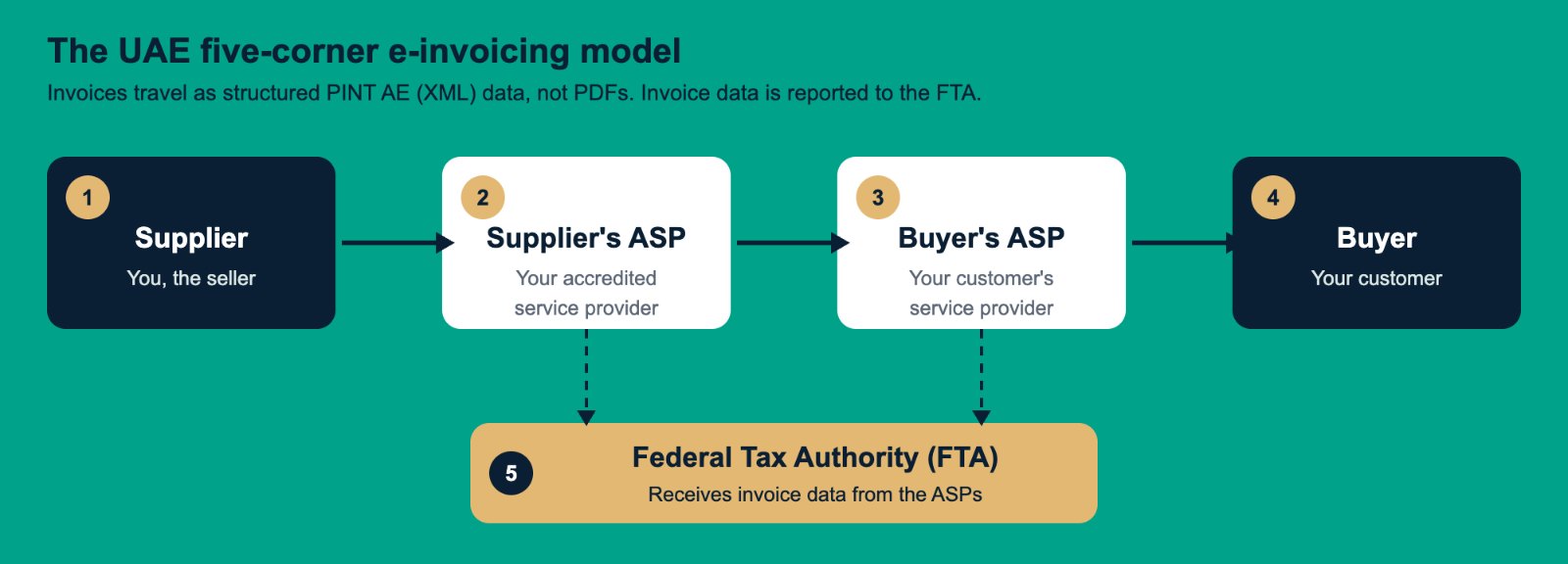
The UAE uses a five-corner model based on Peppol. The supplier's ASP sends the invoice to the buyer's ASP, and invoice data is reported to the Federal Tax Authority (FTA). The rules sit in Ministerial Decisions 243 and 244 of 2025, issued by the Ministry of Finance (MoF). The system covers B2B and B2G transactions. Sales to consumers (B2C) are excluded.
When do UAE SMEs have to start e-invoicing?
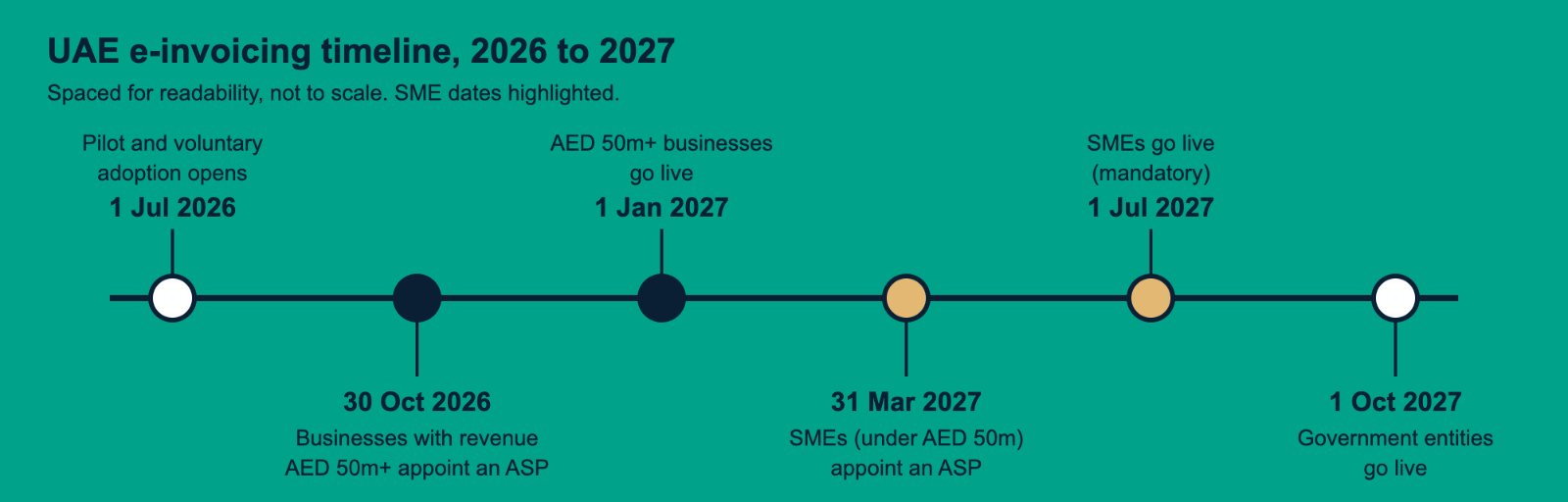
The rollout is phased by revenue. These are the dates that matter:
- 1 July 2026: pilot and voluntary adoption open to any business.
- 30 October 2026: businesses with revenue of AED 50 million or more must appoint an ASP (the deadline was moved from 31 July 2026 by Ministerial Decision 66 of 2026).
- 1 January 2027: those larger businesses go live.
- 31 March 2027: businesses with revenue below AED 50 million must appoint an ASP.
- 1 July 2027: SMEs go live.
- 1 October 2027: government entities go live.
If your revenue is under AED 50 million, your two dates are 31 March 2027 and 1 July 2027.
What happens if an SME misses the e-invoicing deadline?
Penalties are set by Cabinet decision. Published figures include:
- AED 5,000 per month for failing to implement the system or appoint an ASP on time.
- AED 100 per invoice or credit note that is not issued or transmitted on time, capped at AED 5,000 a month.
- AED 1,000 per day for failing to report a system malfunction to the FTA within two business days.
Advisers report that a 2026 Cabinet decision updated the penalty framework, including an overall cap on the monthly fine, so check the latest FTA and MoF guidance before you budget.
What is open finance in the UAE?
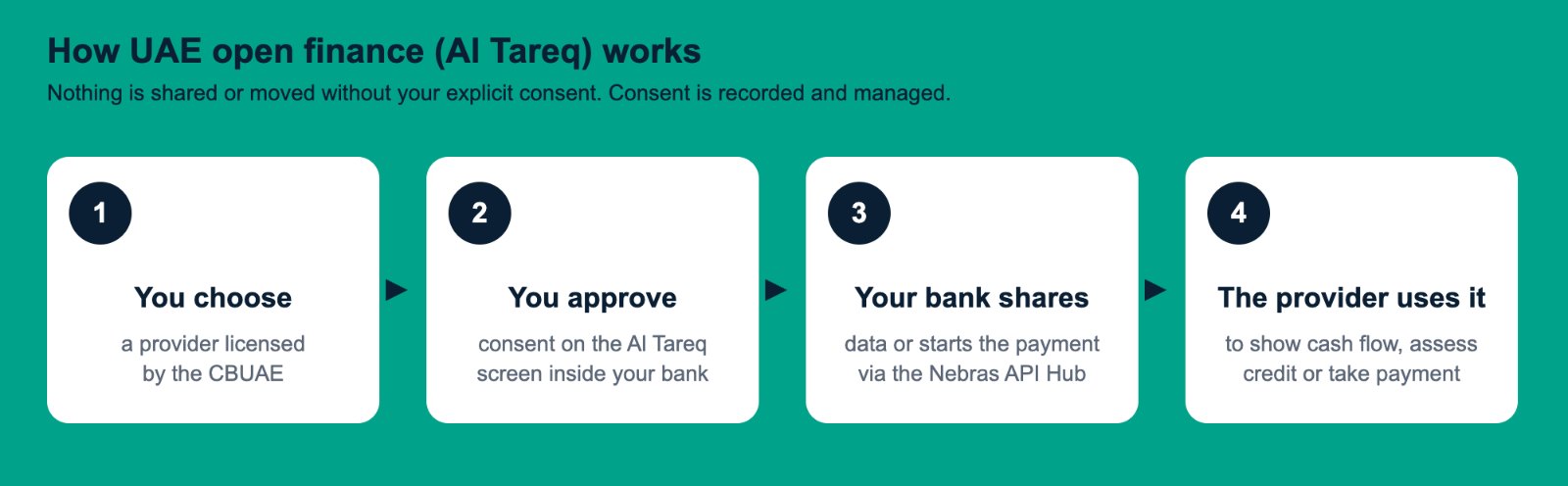
Open finance lets you share your financial data, or start payments, with licensed third-party providers (TPPs) through your bank, with your explicit consent. Nothing moves without it. Consent must be explicit, recorded and managed.
The CBUAE's Open Finance Regulation (Circular 3 of 2025) came into force on 10 July 2025 and replaced the earlier Circular 7 of 2023. It has three parts:
- Trust Framework: the directory, certificates and standards that validate participants.
- API Hub: the single connection point, operated by Nebras, a CBUAE subsidiary.
- Al Tareq: the consent, authentication and payment initiation layer that you actually see.
Phase 1 covers banks, including foreign bank branches, and insurance companies. Other licensed institutions follow in later phases.
Where does UAE open finance stand today?
It is live but early:
- July 2025: ADCB and Pay10 completed the first live open finance transaction on Al Tareq.
- December 2025: Commercial Bank of Dubai (CBD) became the first bank to fully activate open finance for customers, with Pay10 and Lean Technologies.
- January 2026: Abu Dhabi Islamic Bank (ADIB) went live, the first Islamic bank to do so.
- April 2026: ADIB became the first bank licensed as a third-party provider.
- May 2026: the CBUAE said Al Tareq was live with two banks and two third-party providers.
More banks and providers are joining, and the real test will be whether providers build services that SMEs actually want to consent to.
How do open finance and e-invoicing work together for SMEs?
They cover two sides of the same picture. E-invoices record what you sold and to whom, as structured data. Open finance can show what actually landed in your bank account. In our view, lenders will be able to combine the two to judge an SME on verified cash flow, not only on collateral and statements. This is an expectation, not a rule, and it depends on providers and banks building the products.
It matters because SMEs are about 94% of UAE companies but receive roughly a tenth of bank funding (see our guide to what UAE SMBs need from financial providers). Better data is one of the few ways to close that gap.
What should UAE SMEs do now?
- Confirm your phase. Check your revenue for the latest accounting period against the AED 50 million threshold.
- Check your scope. B2B and B2G sales are in. Consumer sales are not. Confirm edge cases with your tax adviser.
- Clean your data. Make sure every business customer has a correct tax registration number, legal name and address. Most e-invoices fail on data, not software.
- Review your accounting software. Ask whether it can produce PINT AE invoices or connect to an ASP. Most SMEs keep their system and connect it to a provider.
- Shortlist ASPs. Use the MoF's list of accredited providers and its February 2026 selection guidance: a verified track record, ERP connectors and information security credentials.
- Appoint your ASP before 31 March 2027, then test issuing, sending, receiving and reporting end to end before 1 July 2027.
- Plan archiving. Plan to keep e-invoices for the legal retention period, which commentators put at seven years. Confirm with your adviser.
- Review your open finance options. Talk to your bank and to licensed providers about what data sharing and account-to-account payments they offer. Share data only with providers licensed by the CBUAE, and review your consents regularly.
- Train your team. Finance staff need to know how credit notes, rejections and corrections work in the new flow.
What's in it for SMEs?
- Fewer errors and disputes. Structured data removes re-keying and mismatched amounts.
- Faster reconciliation and cash visibility. Invoice and payment data can flow into the same system.
- Compliance without penalties. You avoid the monthly and per-invoice fines.
- Better access to credit. Verified cash-flow data can support lending decisions for firms with little collateral.
- Easier onboarding. Consent-based data sharing can reduce repeated KYC paperwork.
- Direct payments from the bank. Customers can pay from their bank accounts with their consent.
Businesses are getting ready: a 2026 survey of more than 500 UAE finance leaders by ClearTax, an accredited provider, put overall e-invoicing readiness at 57.5%. That leaves room for SMEs that move early.
Frequently asked questions
When is e-invoicing mandatory for small businesses in the UAE?
For businesses with revenue below AED 50 million, you must appoint an Accredited Service Provider by 31 March 2027 and go live on 1 July 2027.
Do I need e-invoicing if I only sell to consumers?
No. The UAE system covers B2B and B2G transactions. B2C supplies are excluded. If you also sell to businesses, those invoices are in scope.
Can my business start e-invoicing early?
Yes. Voluntary adoption has been open since 1 July 2026 for any business.
Do I have to replace my accounting software?
Usually not. Most SMEs keep their accounting software and connect it to an ASP. Check that your software or provider supports PINT AE and the five-corner flow.
Is open finance mandatory for my business?
No. Participation is mandatory for CBUAE-licensed institutions, not for businesses. Sharing your data is optional and depends on your consent.
Is my data safe under open finance?
Access requires your explicit consent, strong authentication and a provider licensed by the CBUAE. You can review the consents you gave. Do not share data with providers that are not licensed.
What is Al Tareq?
Al Tareq is the CBUAE's open finance initiative and the consent, authentication and payment initiation layer that customers see. Nebras, a CBUAE subsidiary, operates the central API Hub behind it.
About Avora Money
Avora Money is a UAE business-finance app in development. It is being built to let companies accept payments, manage a business wallet and use cards from one app. To follow our progress, join the waitlist at avora.money.
This article is general information, not legal, tax or financial advice. Dates and penalties can change, so confirm them with the Ministry of Finance, the Federal Tax Authority, the Central Bank of the UAE and your adviser.
This article is general information, not financial, legal or compliance advice.
Sources
- Ministry of Finance: UAE e-invoicing programme
- Ministry of Finance: UAE Electronic Invoicing Guidelines (October 2026)
- HUBPAY: UAE e-invoicing 2027 deadlines, penalties and payments
- Taxually: UAE e-invoicing 2027, ASPs and deadlines
- Vertex: UAE e-invoicing regulations, scope, formats and penalties
- EY Global Tax News: Cabinet Decision 106 of 2025 on e-invoicing penalties
- RSM UAE: e-invoicing penalties confirmed
- Gulf News: UAE e-invoicing deadline for large businesses
- Gulf News: ClearTax UAE E-Invoicing Readiness Index 2026
- Central Bank of the UAE: Open Finance Regulation
- Pinsent Masons: UAE open finance guide
- Crowe UAE: Open Finance, the power shift
- FF News: Pay10 and CBD launch open finance under Al Tareq
- WAM: ADIB first bank licensed as an open finance provider
- Gulf News: how open finance is driving faster credit for SMEs